Bao'an, Shenzhen, China · spring-loaded test probes since 2008
Spring-loaded probes for ICT, FCT and BGA fixtures. 66 series, 0.15 mm to 3.00 mm pitch, 24 tip geometries. Everything photographed on this site was shot here: the plates, the arrays, the microscope, the hands that build them.
What we can put a drawing behind
A probe catalogue is easy to copy. A figure you can send a buyer with the drawing number next to it is not. These four are ours.
series in the LH catalogue. Tables go up family by family, and only where the figures exist on our side.
source: our 2026 cataloguepitch range, spring-loaded. Below 0.30 mm the barrel diameter matters more than the pitch, which is why the tip codes are published with it.
source: our drawingstip geometries: crowns, daggers, needles, flat, cup, and the three-needle enamel-breaking profile. Each with the tip diameter we print.
source: tip-style pageShenzhen Dejiabao Electronics was registered on 7 December 2008. It is the only company date we publish.
USCC 91440300682046400GWhy people write to us
These are the four things in the enquiry emails, in the order they arrive. Each one has a different answer, and none of them start with a part number.
 01
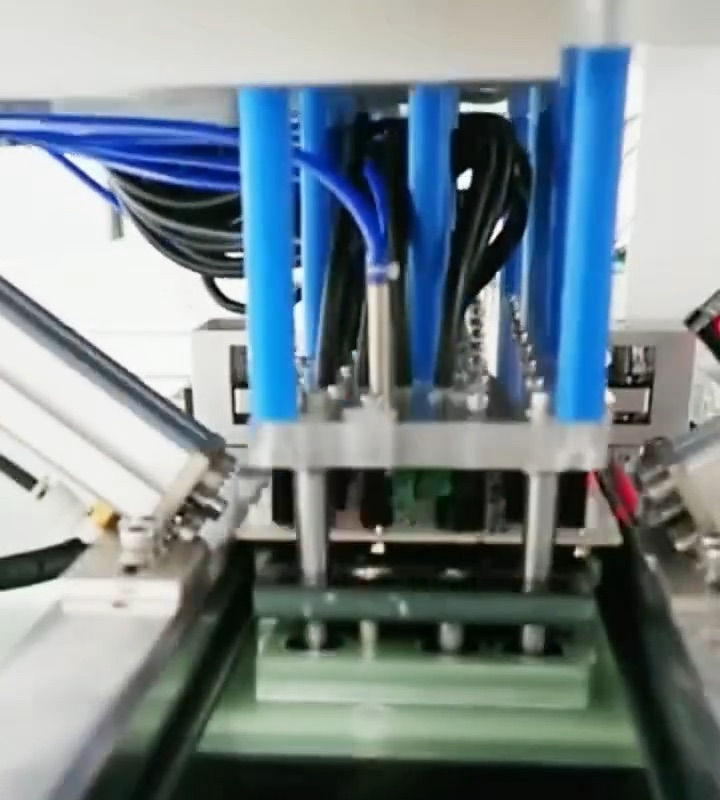
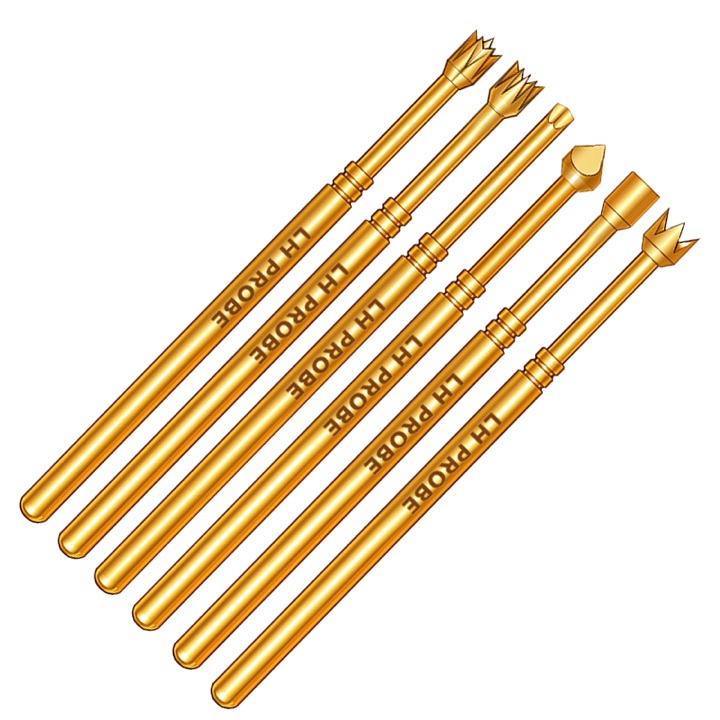
Barrels slim enough to sit between close pads, marked LH PROBE
Continuity passes on some pads and skips on others
At 0.4 mm pitch and under, two things fight each other: the barrel has to clear the neighbouring pad, and the tip has to stay on its own pad while the plate travels through the stroke. Pitch alone does not decide it. Barrel outside diameter does, and then tip geometry does.
Our fine-pitch line (LH-015 upward, down to 0.15 mm) uses small-diameter barrels with needle and three-wave crown tips, so the contact point stays inside the pad through the whole travel instead of walking onto the solder mask next door.
 02
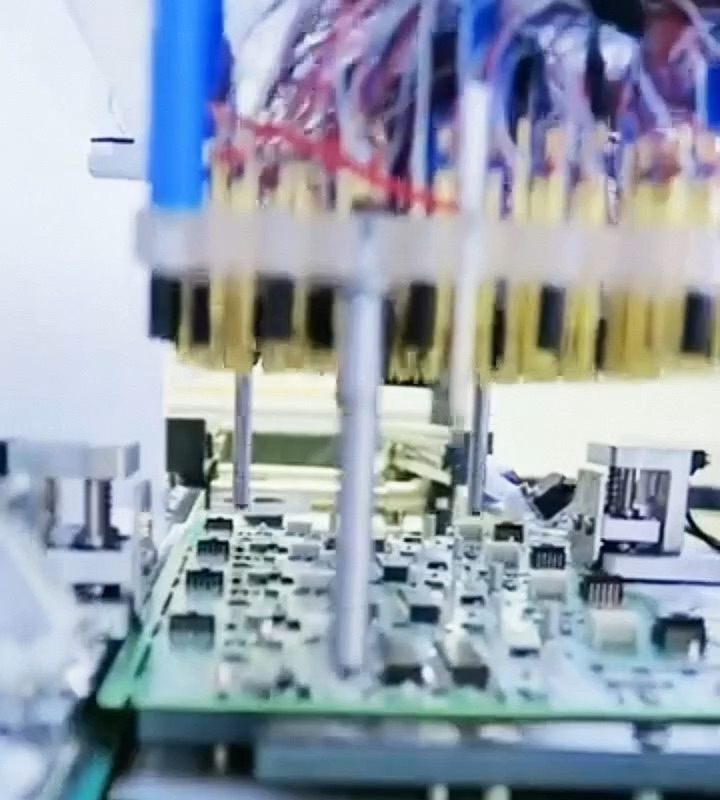
Harness-side view of a bed-of-nails fixture on a loaded board
The first contact reads open, or reads high resistance
A flat tip on an oxidised pad simply sits on the oxide. That is what the high resistance is. Enamel on magnet wire behaves the same way and is harder, so it needs a different profile.
Two geometries do most of the work here: B01, a sharp 30° peak at 0.90 mm that pierces through surface oxide on small pads, and B93, three pressed-steel needles set at 22° for breaking enamel. Between them and B14, the self-cleaning four-point crown, most pad finishes are covered.
 03
Replacing probes into a plate that is already drilled
You are not designing a fixture, you are refilling one
Hole diameter, stroke and retainer spacing are fixed in the plate. A substitute has to match the drilled hole, or the plate is scrap and the project restarts. This is the most common reason a buyer writes instead of ordering.
So the converter carries your length code across exactly as printed, shows which rule it applied, and publishes the 17 confirmed part-number pairs the factory has checked against drawings. The pairs that do not follow the rules cleanly are marked as exceptions rather than deleted from the page.
GKS 100 307 150 A3000, plus a photo of the plate. You get the LH part and the hole diameter from our drawing, so you can check it against your plate before ordering.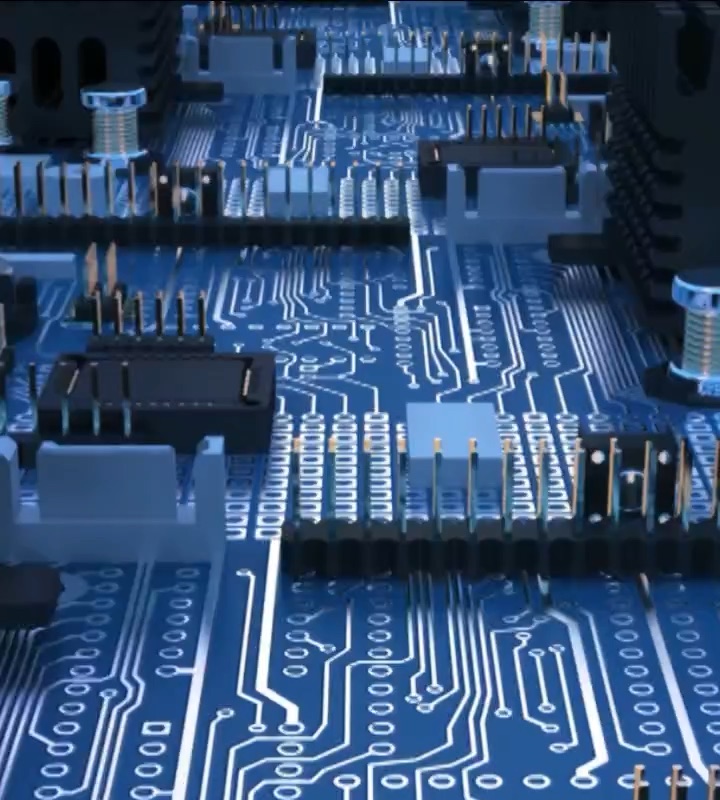 04
Several hundred positions on one board, and one of them is intermittent
Intermittent opens that move around between boards
Three causes, and they look identical from the tester: the spring relaxes, the plating wears through, or a tip burrs and stops making clean contact. Replacing the whole set costs a week of downtime and does not tell you why.
Ours are individually replaceable, and the plunger is gold over hard nickel, so what wears is the plating rather than the base metal. Barrels are phosphor bronze, springs are music spring steel. Batches are kept traceable to the plate they went into, so a bad batch can be named instead of guessed at.
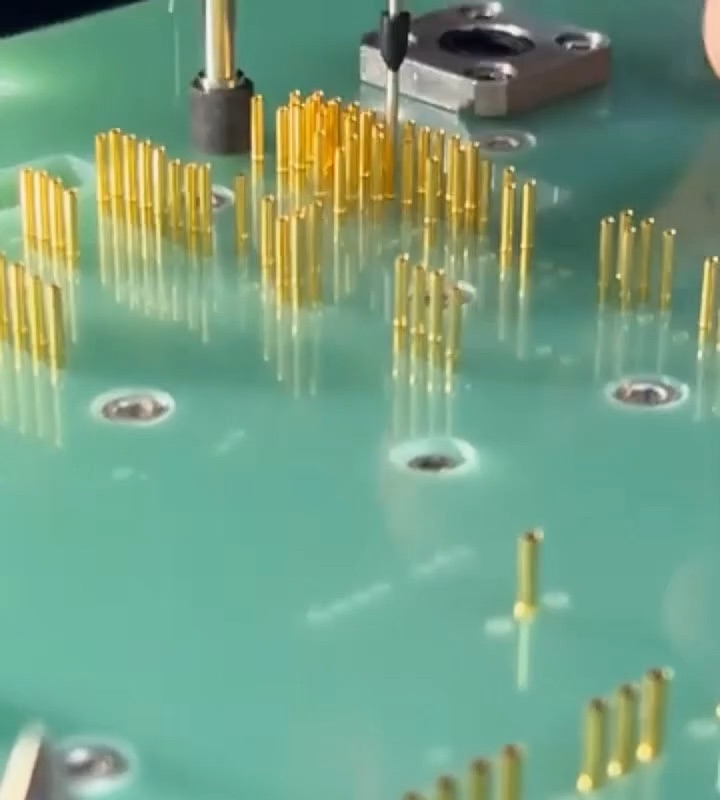
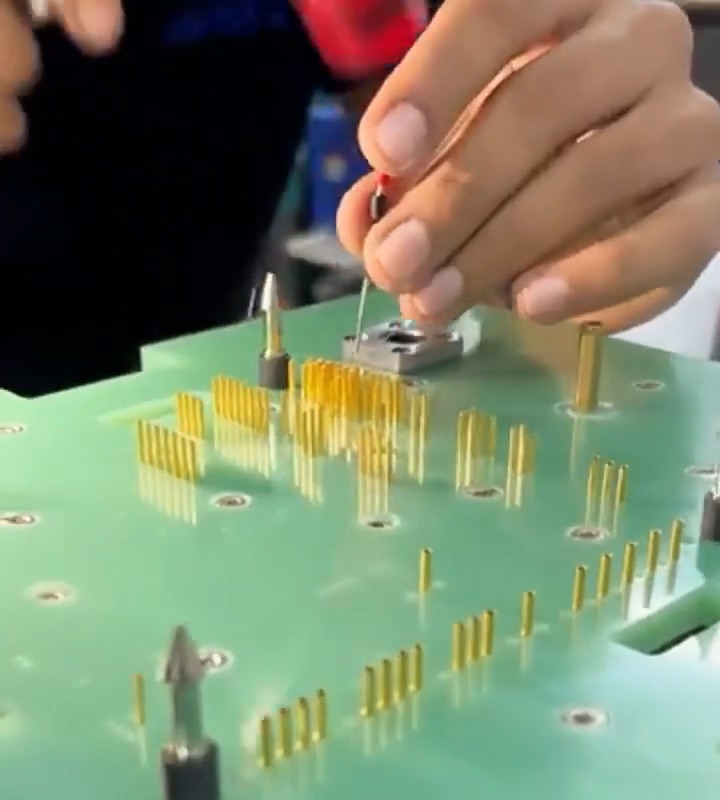
Filmed in the workshop
Building 3, No. 119 Xiner Road, Xin'er Community, Xinqiao Street, Bao'an. Click any clip to start it.
Three of the four are camera footage from the benches in Building 3; the fourth is the catalogue animation of the barrel marking and is labelled as such. The domestic cuts of this footage carry Chinese subtitles burned into the picture, and one of them ends on a card belonging to a different company. These versions are cropped above the subtitle band and that ending is cut off, which is why they are square rather than vertical.
The line
The catalogue counts 66 series. Below are the families we can back with drawings; the ICT/FCT page is live now and the others follow as their figures land on our side, plus the wire and tungsten micro-probe line. The fifth numbered family in the catalogue, rigid PIN types, is not being offered for export at present.
Bed-of-nails work. Published stroke, spring force and current rating for the four main series, taken from our own drawings one at a time rather than from a brochure.
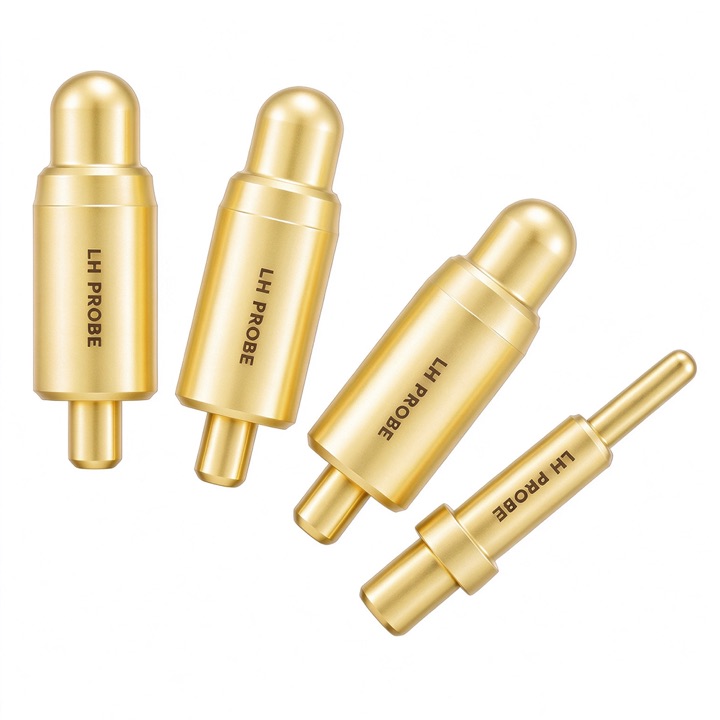
Spring-loaded probes for in-circuit and functional fixtures where the pads are close together. Finest pitch 0.15 mm; barrel outside diameter is published with each series because that is what decides fit.
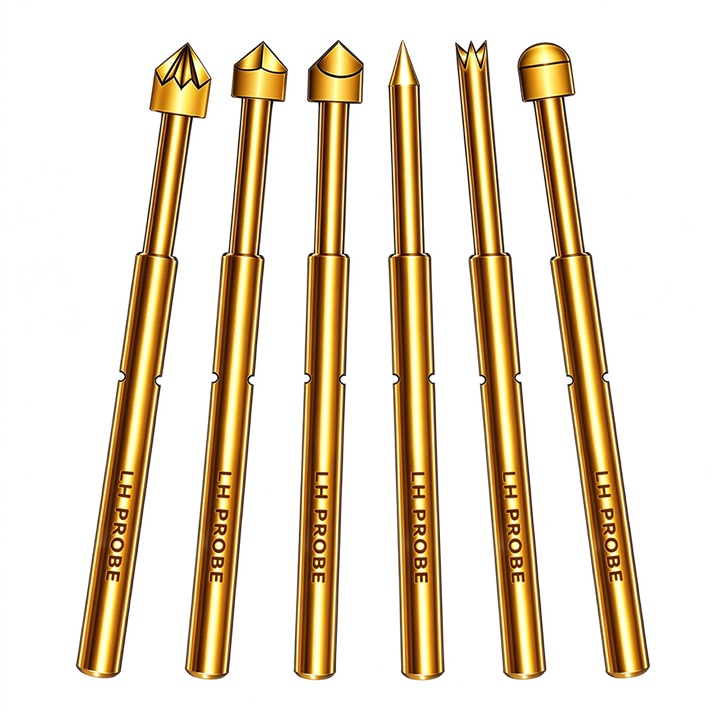
LHP-025 to LHP-136, including the 048L and 068L long bodies for deep fixtures.
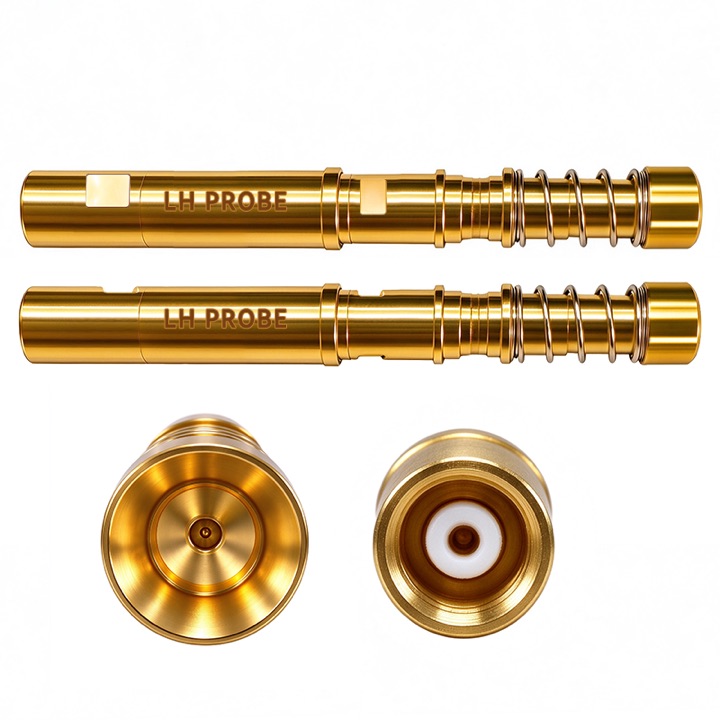
LHRF and LH-GPP coaxial contact probes for RF test points, plus SMA-mounted assemblies. The face view is what makes this family different: centre conductor, dielectric, outer shell.
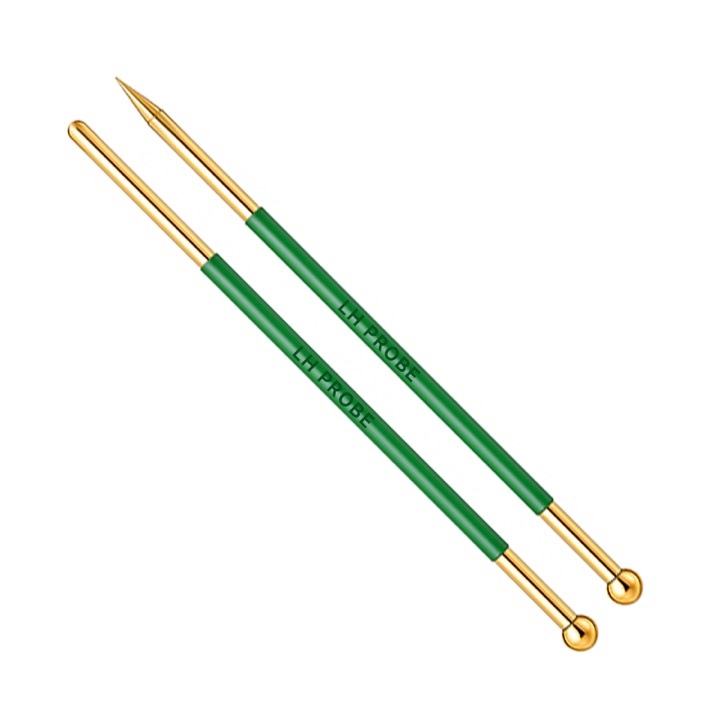
Non-springing wire probes and tungsten micro-needles. Contact resistance is quoted per drawing here, because a spring-probe figure does not transfer to this type.
Free tool, no sign-up
Try GKS 075 214 064 A2000 · GKS 100 307 150 A3000 · KS-075 47G · GKS 003 206 254 A2000
Type the number marked on the probe you are using. The tool applies the six series rules the factory published, carries your length code across as printed, and tells you which rule it used. Where the answer is a close recommendation rather than an equivalent, it says that too.
| INGUN series | LH series | Pitch | INGUN series | LH series | Pitch |
|---|---|---|---|---|---|
| GKS 040 | LH-061 | 1.00 mm (.039) | GKS 100 | LH-137 | 2.54 mm (.100) |
| GKS 050 | LH-078 | 1.27 mm (.050) | GKS 003 | LH-200 | large pitch |
| GKS 075 | LH-102 | 1.91 mm (.075) | GKS 004 | LH-236 | large pitch |
Tip codes, the three published force codes and nine receptacle equivalents are on the full converter page, together with all 17 confirmed pairs.
Tip geometry
Tip shape decides how the probe cleans itself, whether it breaks through enamel, and how much force actually reaches the pad. Twenty-four geometries are published. What is shown here is the point: one barrel, several tips, and the plate does not care which one you put in.
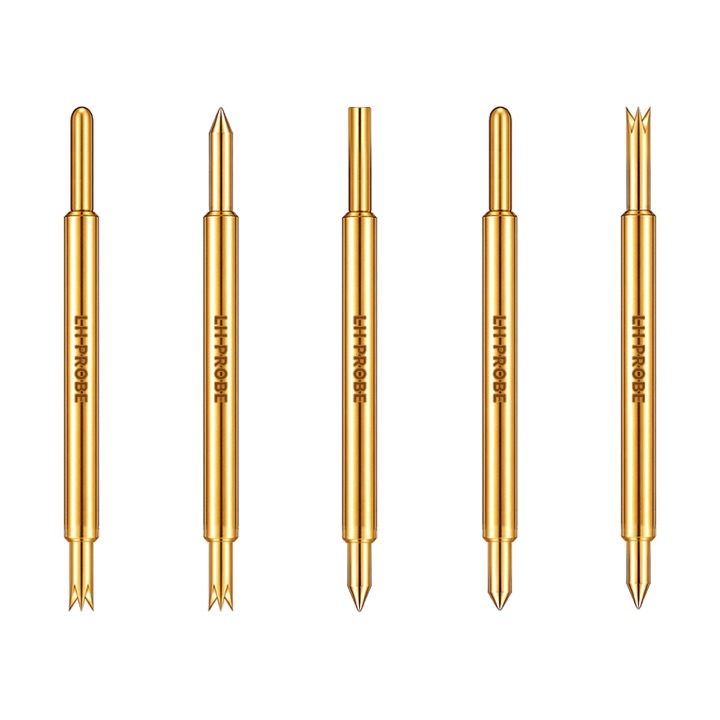
One body, five tips. From needle to crown, the barrel stays the same so the plate does not have to be re-drilled.
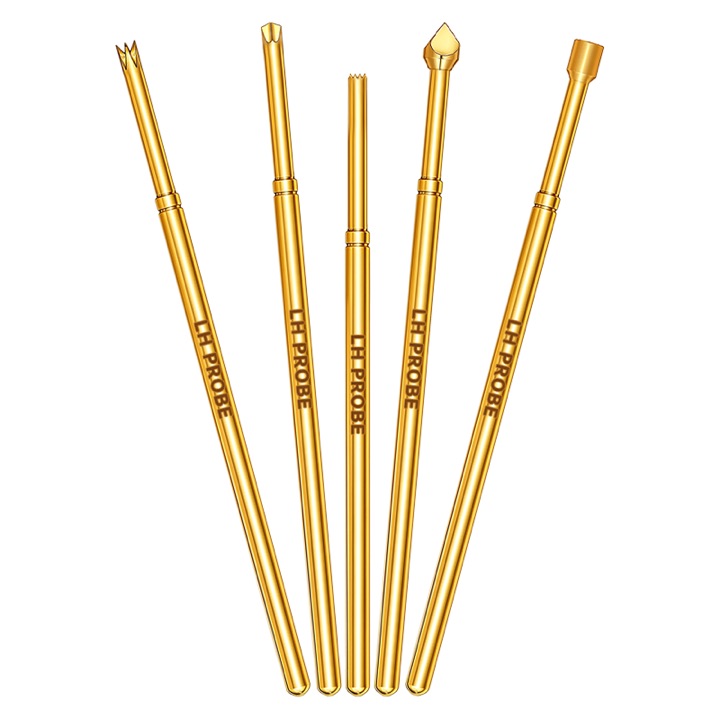
The GKS 040 equivalent line. Long body, tip options at both sharp and crown profiles.
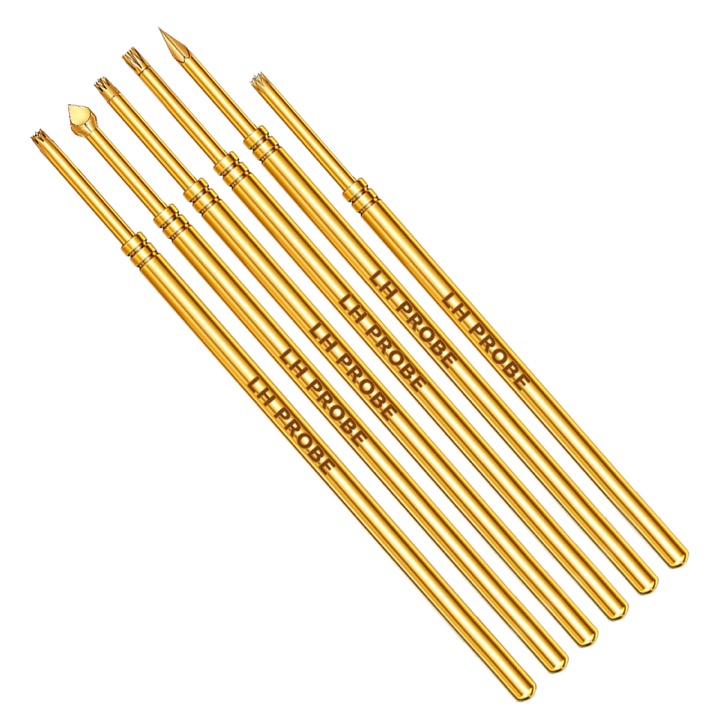
GKS 050 equivalent. Long body at 1.27 mm (.050), the inch-standard pitch a great many older fixtures were built on.
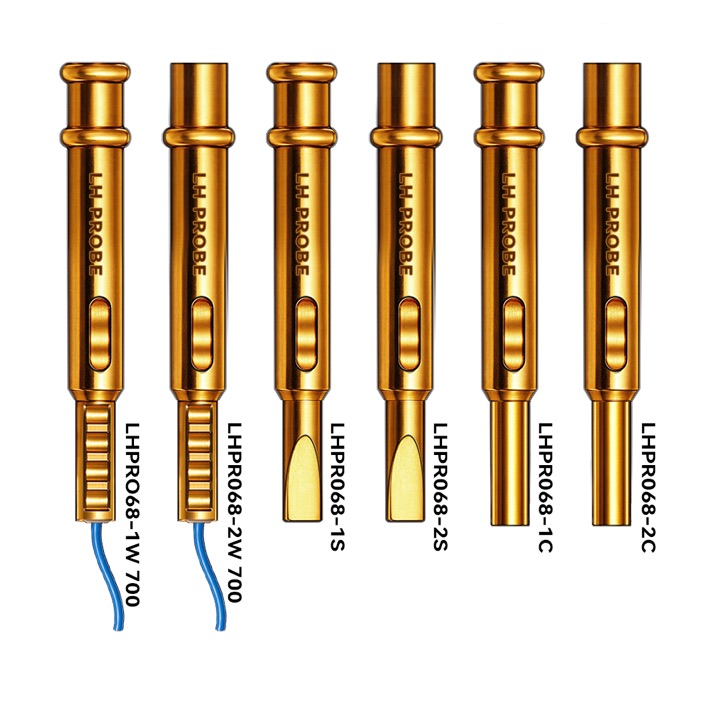
Receptacles: the other half of the contact pair, solder-cup and wire-lead forms shown together.
All 24 tip codes with diameters, and which geometry suits oxidised, enamelled and fragile pads
Materials and testing
As printed in our 2026 catalogue. Where a figure has not been confirmed we write the specification instead of a number.
Hardened beryllium copper, gold plated over hard nickel. The nickel is the wear layer; the gold is for contact resistance.
Phosphor bronze, gold plated.
Music spring steel, gold plated.
Published only for the series where a figure has been confirmed. For the rest: to customer specification.
Assembly bench, Xiner Road, Bao'an
Who is making the probe
Dejiabao makes the probes it sells. The office is at Vanke Xingcheng; the assembly benches and the inspection work are at the Workshop 201 address on Xiner Road, both in Xinqiao Street, Bao'an District, Shenzhen, China. The Shenzhen company was registered on 7 December 2008.
Product lines: mobile-phone BGA test fixtures, computer BGA fixtures, digital-product fixtures, PCB test systems, test probes, test modules, and fixture peripheral materials. Applications cover RF, BGA, ATE and FCT/MDA work, from open/short and resistance through to capacitance, inductance, diode, transistor, voltage and IC measurements.
Enquiry
If we have the equivalent we will quote it. If we do not, we will say so rather than send you something close and hope.
513, Building 2, Vanke Xingcheng Commercial Center, Xinqiao Street, Bao'an District, Shenzhen, Guangdong, China